
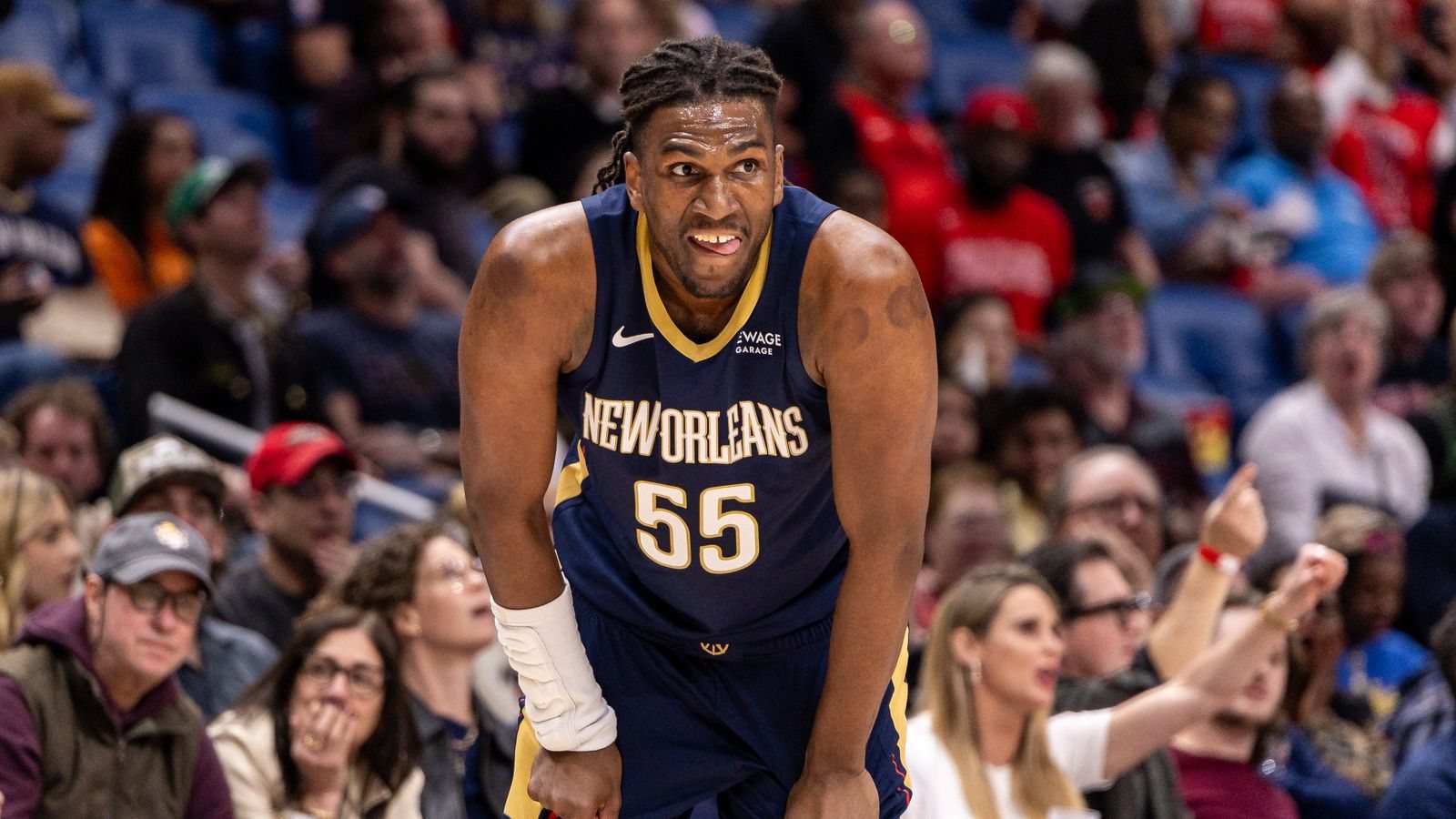
Walker Kessler was out for a third straight preseason game Thursday night with a finger injury, per Sports Illustrated’s injury report. His absence puts the backup centers in the spotlight, and the question is who plays behind him when he is back. The obvious candidate is Sandro Mamukelashvili, the 38.9% three-point shooter. I think it should be Kevon Looney, and the rebounding numbers are why.
My take: the Lakers hired Kessler to anchor the defense and clean the glass. The man behind him has to do the same job for 12 to 15 minutes a night, and only one of the two candidates does.
What Kessler does
Kessler’s last healthy season was 2024-25 in Utah, where he played 58 games and averaged 11.1 points, 12.2 rebounds and 2.4 blocks in 30.0 minutes, per Basketball Reference. His total rebound percentage, the share of available rebounds he grabbed while on the floor, was 21.9%. His block percentage was 7.4%. His usage rate was 13.7%, a low number for a starter. He is a rim protector and a rebounder. (He played only five games in 2025-26, which I covered in how he ended up a Laker.)
The Lakers are paying him $30.2 million this season, per Basketball Reference’s roster page, which is what the franchise thinks that skill set is worth. The reserve has to protect the same thing.
The two candidates
Here is each man’s most recent line, per Basketball Reference. Kessler’s is from 2024-25 because he played only five games in 2025-26, and Looney’s rests on 21 games:
| Player | Team | Games | Minutes per game | Rebound % | Offensive rebound % |
|---|---|---|---|---|---|
| Walker Kessler (2024-25) | UTA | 58 | 30.0 | 21.9 | 16.6 |
| Kevon Looney (2025-26) | NOP | 21 | 14.7 | 20.6 | 16.6 |
| Sandro Mamukelashvili (2025-26) | TOR | 80 | 21.9 | 12.8 | 6.9 |
Looney’s offensive rebound rate, 16.6%, matches Kessler’s exactly. Mamukelashvili’s, 6.9%, is less than half of it. His block percentage was 2.3%, against Kessler’s 7.4%. He plays center, but he does not do a center’s work on the glass or at the rim.
Looney is 30 and has three championships from his years in Golden State, per Yahoo Sports. The Lakers signed him to a one-year, $3.9 million deal on July 7, per ESPN, and made it official July 13. His 2024-25 season with the Warriors, 76 games at 15.0 minutes and a 21.8% rebound rate, shows what he does when healthy and rested.
The case against Looney
Looney’s 2025-26 was thin: 21 games and 308 minutes for New Orleans, 2.8 points and a .458 true shooting percentage. He shot 15.4% from three on a handful of attempts. He is no floor spacer.
Mamukelashvili is the reverse. His true shooting was .637 on 11.2 points per game last year, and he made 38.9% of 3.7 threes a game in 80 games. He started at Golden State on Oct. 6 and scored 15, per ClutchPoints.
Mamukelashvili’s shooting is real, but the Lakers have shooters. Reaves hit 36.0% from three on 6.4 attempts last season and Doncic 36.6% on 10.8, so the backup five does not have to supply it. What they lack is a second big who finishes a possession by securing the miss, and the group playing without Kessler needs exactly that.
The price of Looney’s offense
The real cost shows up in lineups. Looney attempted 0.6 threes a game last season, per Basketball Reference. Jarred Vanderbilt shot 29.3% on 1.5 attempts a game for the Lakers. Put those two on the floor together and defenders can sit in the lane and ignore both, which crowds Doncic’s drives. That crowding is why I would not pair them for long stretches.
It is also why the minutes should be short. Looney played 14.7 a night in New Orleans and 15.0 in Golden State in 2024-25. Yahoo Sports notes he led the NBA in offensive rebounds in 2022-23 with 274 and averaged a career-high 9.3 rebounds over 82 games that year. That is the version the Lakers are paying for: a rebounder who plays a dozen minutes.
How I would split the minutes
This is how I would split them:
- Looney first off the bench. He covers the backup-five spells when Kessler sits and the Lakers need to end possessions.
- Mamukelashvili when Doncic runs the bench group. A shooting five gives a driver room to work.
- Vanderbilt as the smaller fallback. Jarred Vanderbilt, who is on the books at $12.4 million, grabbed 15.2% of available rebounds in 65 games last season, per Basketball Reference, which is better than Mamukelashvili. He plays forward, and he covers the rebounding gap in a small lineup.
The split puts Looney in the role the team signed him for, which Yahoo Sports described as competing for minutes as a backup big, and uses Mamukelashvili where his shooting adds something Looney can’t.
What the preseason can tell us
The sample is tiny. With Kessler sidelined, per SI, the Lakers have not seen any of these groupings with their starting center. The meaningful minutes are the last preseason games, Oct. 13 against Golden State in Las Vegas and Oct. 16 against Denver, followed by the Oct. 21 opener against the Warriors. The preseason dates are per Heavy, the opener per Basketball Reference.
Here is what I will watch:
- Who plays the first Kessler-less minutes. If it’s Mamukelashvili, Redick chose spacing over the glass.
- Defensive rebounds when Kessler sits. The opponent’s second-chance points will tell me quickly.
- Looney’s shot selection. If he takes jumpers, the experiment is over.
For the bigger picture of how the team lost LeBron’s passing and what it added, see what LeBron’s departure took with it. And for the Oct. 6 preseason loss where Mamukelashvili started, read the Redick “unacceptable” game.
The Lakers paid for a rebounder and a shooter. They should play the rebounder behind Kessler. For the guard side of the second unit, see why Collin Sexton is the bench scorer to build around.
Update: after Kessler’s 12-for-12 debut, I broke down which part of it is repeatable.