
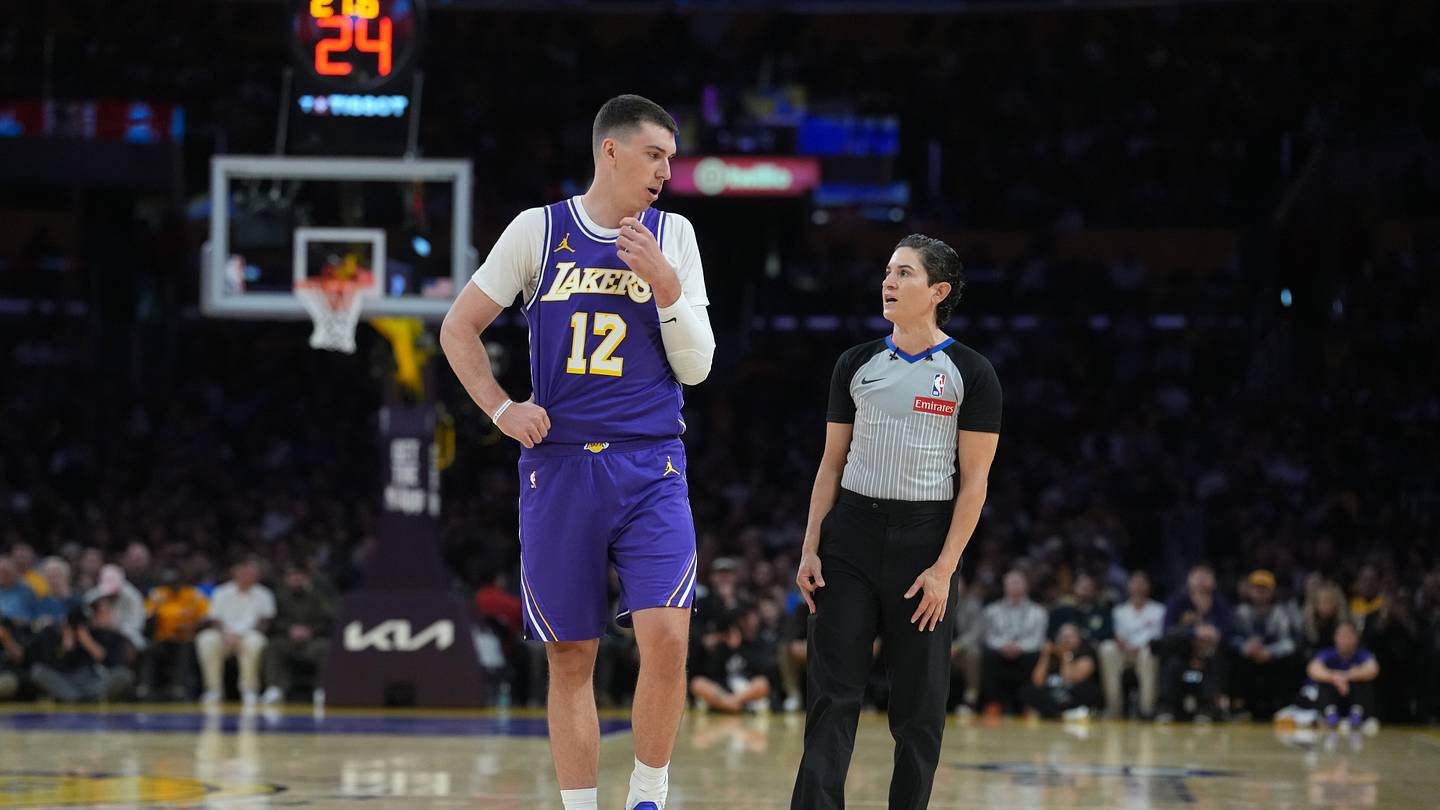
Jake LaRavia has committed 43 personal fouls in 294 minutes. That’s a whistle roughly every seven minutes, calculated from Basketball Reference’s Lakers totals through the Nov. 11 game in Milwaukee. A player who helps by getting to the next loose ball cannot keep giving the referee this much work.
I want LaRavia in the rotation. I also want JJ Redick to make fewer fouls a condition of keeping a substantial role. As of Sunday, Nov. 15, the case for him is easy to find: offensive rebounds, extra passes and enough shooting to punish an abandoned corner. None of those jobs requires reaching across a shooter’s arms. LaRavia can keep his edge and exercise some judgment about where to spend it.
The raw total undersells the problem because LaRavia isn’t playing star minutes. Basketball Reference has him at 24.5 minutes per game across 12 appearances. His 43 fouls work out to about 5.3 per 36 minutes. That’s a pace that leaves very little room for an ordinary collision or a late rotation, the sort of contact that can happen even when a defender makes a reasonable decision.
Compare him with Matisse Thybulle, who has 25 fouls in 317 minutes on the same Basketball Reference table. That’s about 2.8 per 36. Walker Kessler has 39 in 400 minutes, about 3.5 per 36. It does show that LaRavia’s foul pace deserves attention beyond a shrug about playing hard.
Thybulle is especially useful here because his hands are busy, too. Basketball Reference credits him with 28 steals and 11 blocks, against LaRavia’s 15 steals and eight blocks. They do make it hard to accept the idea that a defender has to foul this often to get involved. Thybulle’s production is a useful answer to anyone treating discipline as a request to stop competing.
The standard I’d set is simple: keep making the opponent work, then finish the possession with enough control to stay available for the next one. I would rather have LaRavia contest a difficult jumper from a sound position than gamble on touching the ball after the shooter has already created space. That’s a coaching preference, not a diagnosis of all 43 fouls. The total tells us there is a problem; it doesn’t tell us which individual whistles were avoidable.
Milwaukee is the best reason to demand better without giving up on him. In Basketball Reference’s Nov. 11 box score, LaRavia finished with seven offensive rebounds, nine total rebounds and six assists in 20 minutes, 46 seconds. He scored zero points on four shots. He also committed two fouls. That is an awfully useful night for someone whose own jumper contributed nothing.
That performance shows what the Lakers should be trying to preserve. He can create another shot without having a play called for him. He can move the ball after a rebound instead of insisting that recovering it entitles him to fire. His value can survive an empty scoring column. If I’m Redick, that’s the version I want to encourage, with the defensive restraint treated as part of the performance rather than a separate favor.
The contrast with the Nov. 6 Portland box score is sharp. LaRavia collected five offensive rebounds and eight total rebounds in 24 minutes, 35 seconds, but also six fouls. There was good work in that game. There was also a limit on how much more of it he could offer. The Lakers shouldn’t need to choose between getting his extra possessions and worrying about his next whistle.
I wouldn’t turn those two games into proof of a permanent fix, or pretend the difference in his playing time came entirely from fouls. What they give Redick is a reasonable demand. LaRavia has already produced a busy rebounding and passing night while keeping the foul total down. Ask him to repeat the combination. Don’t let the presence of useful plays excuse every expensive one.
This matters because his offensive rebounding is a substantial part of the team’s supply. Basketball Reference lists 26 offensive boards for LaRavia and 147 for the Lakers through Nov. 11. That’s about 18% of the team’s total. Yesterday’s case for sending LaRavia after Phoenix’s misses was about exploiting an opponent. The longer-term issue is keeping that contribution on the floor without letting the fouls consume his role.
His shooting gives Redick another reason to work through it. He’s made 12 of 23 threes, per Basketball Reference. I like the makes. I would also keep the denominator in view before treating him as a finished answer to the Lakers’ spacing needs. Our earlier argument for more LaRavia three-point volume still applies: a forward who can rebound and make himself available for an open jumper gives the offense more ways to survive a difficult possession.
I’d have Redick substitute when LaRavia starts chasing a possession he has already lost. A short substitution can carry a clearer message than allowing him to stay on the floor until the foul count makes the decision. He should earn the next stretch by doing the boring defensive work well, including accepting that a contested make sometimes beats an unnecessary attempt to rescue the play.
That shouldn’t become an automatic hook for every foul. A forward who is afraid of contact won’t help much around the basket. I’d judge the decision: was he in position, was the contest controlled, and did he have a plausible chance to affect the shot? Those are the questions worth answering possession by possession. A season total is the warning light, not a substitute for watching what caused it.
For the next stretch, I would watch the possessions after his first foul especially closely. Does he adjust his distance on the next closeout? Does he trust the help behind him? The useful response is a better decision on the next trip, rather than an argument about how much contact the officials should allow.
LaRavia’s seven offensive rebounds in Milwaukee are worth protecting. So are the six assists. The way to protect them is to ask for more of that night’s two-foul discipline. Keep chasing the ball. Give the whistle fewer reasons to follow.